
Nanni v. Ea-nāṣir
Around 1750 BCE, in the city of Ur, a man named Nanni bought copper from a merchant named Ea-nāṣir. The copper was bad. Nanni pressed his complaint into clay.
You promised my man fine copper. Then you showed my messenger bad ingots and said, take them or leave. Who do you think I am? I sent gentlemen for my money and you sent them back empty-handed, more than once, through enemy territory. Here, I pick out the copper myself, piece by piece.
Abridged and paraphrased by the Department. The best-known English translation is A. Leo Oppenheim's, in Letters from Mesopotamia (1967).The tablet was excavated at Ur in the 1920s, and other tablets complaining about Ea-nāṣir turned up in the same house. He kept them. It is now in the British Museum's collection. The messenger in the letter, Gimil-Sin, now staffs Window 3.
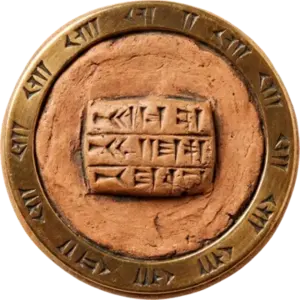
The oldest written customer complaint
According to Guinness World Records, Nanni's tablet is the oldest written customer complaint. We think that makes this the oldest complaint department in history, so we kept it open.
The medallion is our own artwork. BadCopper is independent and is not affiliated with, endorsed by, or sponsored by Guinness World Records.
How it works
1. Carve it. Free.
Write who wronged you, what they did, and an optional seal. Up to 500 characters. No sign-up.
2. Let it dry. Free.
Your wet clay gets a link and an image. Share it, keep it, or smash it. It crumbles after 30 days.
3. Fire it. $5, once.
Fired tablets get the next complaint number and go on the public record, permanently. Clay can't be unfired.
Questions
What is this?
A complaint department that has been open since 1750 BCE. Write a grievance on a clay tablet, share it free, and pay $5 if you want it fired forever.
Can I delete it?
No. That's the point.
Wet clay you can smash any time. A fired tablet stays on the public record forever. If one breaks the rules we take it off our own pages, images and the Hall and delete our copy of the text, but the public record stays.
What's wet clay?
A free draft. We store it, you can share it, you can smash it, and it crumbles after 30 days unless you fire it.
What does firing do?
It carves your tablet permanently into a public record and gives it the next complaint number. $5, once. Nobody, including us, can change or delete it afterwards.
Is this a crypto thing?
Under the hood, yes. A fired tablet is stored on the Base blockchain, with the full text kept in the contract itself, which is why nobody can alter or delete it and why anyone can verify it without us. Each tablet's page has a Provenance section with the links. You don't need to know anything about crypto to write or share wet clay.
How do I pay?
Firing is available now outside the EU, EEA and UK. Use a Base Account with a passkey, or connect a compatible wallet. Pay in USDC, or ETH when offered. The firing step shows the current price; review any network fees in your wallet before signing.
Why can't I fire a tablet in the EU or UK?
Their right to erasure and our "can't be erased" don't mix. The full explanation.
What can't I write?
Threats, personal information (addresses, phone numbers, emails), links, slurs, and anything illegal. Everything else is between you and Shamash. The house rules.
Can a business reply, or pay to remove a complaint?
No replies, no profiles, no ratings, no search by name. And we never remove complaints for money.
Is my name public?
Only the seal you choose, which can be anything or nothing. If you fire a tablet, the account that signed it is visible on the public record.
Who is Shamash?
The Mesopotamian sun god and judge. Ea-nāṣir's customers opened their letters by asking Shamash to keep him well, and then got to the copper. Invoking Shamash on a tablet is our version of a like: one per visitor.
Who made the art?
The relief illustrations and Gimil-Sin are AI-assisted and edited by us. The tablet photo is by Zunkir, CC BY-SA 4.0, via Wikimedia Commons. Fonts: Cinzel, Source Serif 4 and Courier Prime (SIL Open Font License).
Something else? complaints@badcopper.net. We read everything. Obviously.